


Filters
1107 products



Cannot find the right part?
Get in touch. If it is not on the site, it has not made it there yet. Tell us what you need and we will see what we can do.
Buying guide and details
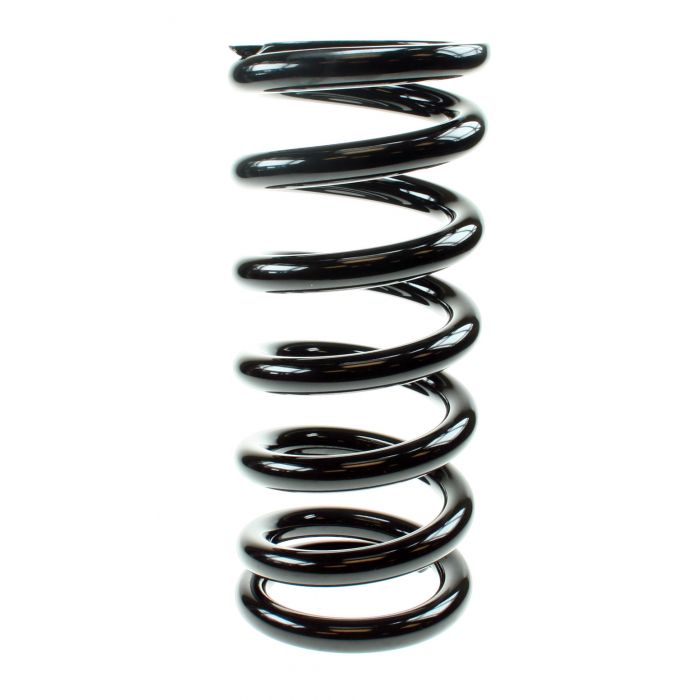
The main spring carries the weight of the car, the helper keeps it seated on the perch when the wheel drops into extension. H&R writes the rate in N/mm, BC Racing in kg/mm, and 1 kg/mm is 9.81 N/mm. They are chosen by inside diameter, free length and rate.
The five kinds of spring
- Straight spring. The rate stays the same from the first millimetre to the last, so the car behaves the same over a small bump and under hard braking. H&R main springs and BC Racing straight springs sit here.
- Barrel spring. The middle is wider than the ends, and the rate rises as the spring compresses: soft to begin with, firm once the load arrives. BC Racing calls them S barrel.
- Tapered spring. The ends have different diameters, 62 mm at the bottom and 85 mm at the top for example, and they go where the upper perch is not the same size as the lower one. The rate is variable here too. At BC Racing they are V barrel.
- Helper spring. It has a very low rate, just enough not to change how the suspension behaves, and it keeps the main spring seated on the perch when the wheel drops into extension. It goes in series with the main spring, above or below it.
- Formula spring. A separate H&R programme, 36 mm inside diameter, made for single seaters.
Helper or progressive tender spring
Both sit next to the main spring, but they do different jobs. A helper covers the gap left between the perch and the spring, and that is all: it goes coil bound on the first load and from there on it plays no part. A progressive tender spring, the one with two figures in its rate, of the 30 to 100 N/mm kind, works while it is still open and softens the first part of the travel, then goes coil bound and leaves the main spring on its own. H&R makes them from trapezoidal wire, which takes being held coil bound permanently.
The three figures you choose on
- Inside diameter is set by your coilover, not by preference: the spring has to seat on the perch. On BC Racing the standard perch is 62 mm, on H&R race springs 60 and 64 mm are the common ones.
- Free length is chosen for the damper travel. Too short and the spring unloads at full extension. Too long and it eats the ride height adjustment.
- Rate says how stiff the spring is. It goes up for aero and for weight on the axle, and down on broken surfaces, where the wheel has to be left to work.
How to read the code
At H&R, HRF 180-60-050 means 180 mm free length, 60 mm inside diameter and 50 N/mm. At BC Racing, 62.180.003.5S means 62 mm inside, 180 mm length and 3.5 kg/mm, and the letter on the end gives the shape: S for barrel, V for tapered.
N/mm and kg/mm, the same stiffness
The two brands write the rate in different units, the way their manufacturers write them. One kilogram per millimetre is 9.81 newtons per millimetre, so an 8 kg/mm spring is roughly a 78 N/mm spring. When you compare two springs from different brands, put both rates into the same unit first.
If you are not sure what suits you
Write to us with the coilover you have and how you use the car. We are the authorised BC Racing importer and we can have the figures confirmed by them directly. The complete BC kits are in BC Racing coilover springs.